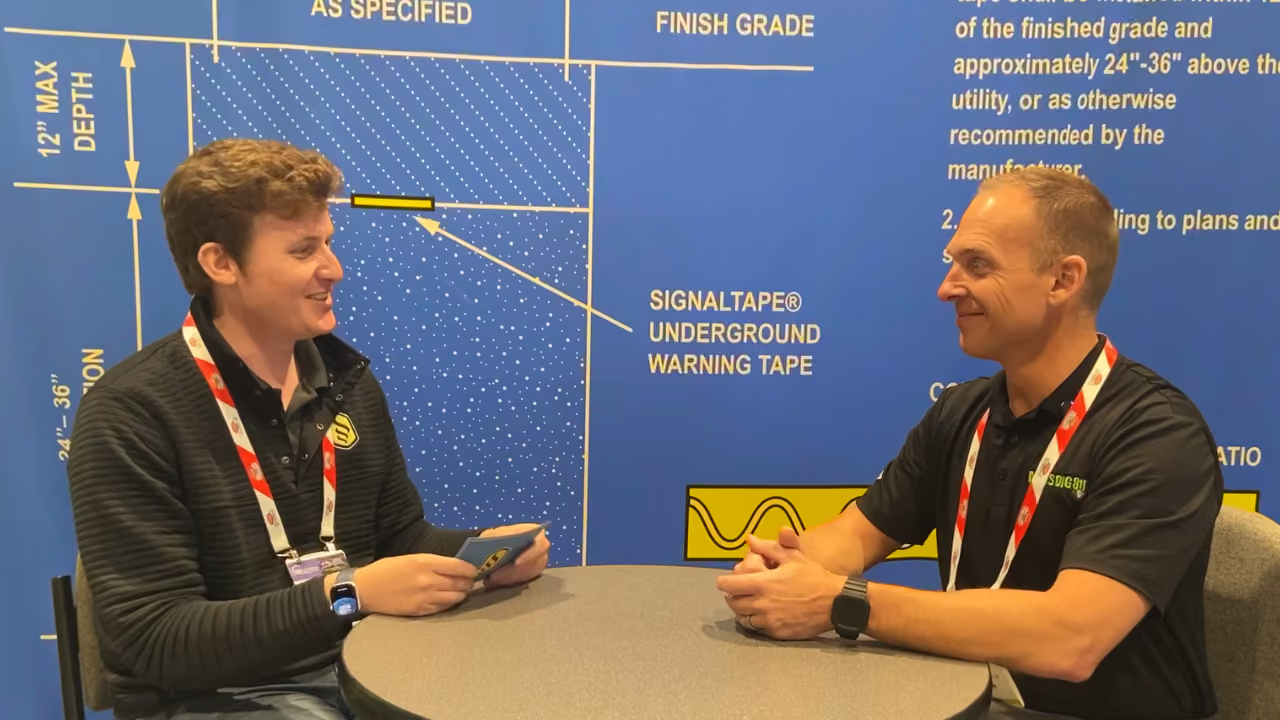
Henry Brophy (Damage Prevention Solutions): "Hey, Daniel, thanks for joining me at the Damage Prevention Solutions booth. How's the show been going for you so far?"
Daniel Mee (Cadent): "Yeah, it's been really good so far. It's been good to see how the US and the UK have the same challenge ultimately, and approach it differently and see some of the best practice over here. It's been good to share some knowledge and get some, insights, some opportunities."
Henry: "Awesome. Well, I think before we start the conversation do mind just introducing yourself, your company, your role, just kind of going from there."
Daneil: "So I'm Daniel Mee. I’m an Engineer Manager for Asset Protection at Cadent. So Cadent are a UK gas distribution company. We also have a local transmission part of our network. So we have around 82,000 miles of pipeline, ranging from high pressure in the sort of 60, 70, 80 bar range right way down to low pressure, distributing gas to 11 million homes and businesses."
Henry: "Wow, wow. That’s a lot. We cover like the central part of the UK, coming from north London, across the east coast, up to the Humber, across the top of Manchester into the Lake District, and then down the Welsh border beneath Birmingham and back diagonally to London."
Henry: "Okay, got it yeah. Picturing the map."
Daniel: "So we cover, half of the UK's gas customers, but only cover around a third of the sort of landmass in the UK, so quite a densely populated area, with London, Manchester, Birmingham, in that sort of area."
Henry: "Awesome. Well, the theme of the booth this year is “Preventing Damages by Design”. So just kind of wanted to understand what that looks like in the UK and your role as well."
Daniel: "Yeah, so for my role as Engineer Manager, my role is all around the framework that sits around damage prevention. So, within our team we cover everything from asset design and construction in terms of the policies, the procedures. So, we’ll cover preventing it by design in terms of the routing. In terms of proximity to other assets, the maintenance requirements, who can work around it, marker systems, above ground, below ground, but then for me, it's all around our framework for damage prevention. So asset awareness: how do people know that our assets are there? Stakeholder liaison: how do we continually remind them on the requirements? How do we manage tickets, inquiries, slightly different here to the UK, and then sort of surveillance. So how do we identify non-notified works and manage them appropriately and sort of do that whole continuous improvement piece. Yeah, just trying to move in the right direction as a whole team."
Henry: "Yeah, and it's a little different, just the UK and US, but when you know projects are getting started, when does the conversation around damage prevention kind of come into the picture? Is it like, how is engineering kind of thinking about damage prevention?"
Daniel: "Yeah, so for us in terms of us as we're obviously an excavator and an asset owner. "
Henry: "Okay."
Dnaiel: "So we obviously excavate on our own assets. So, there's a bit of a dual role. So, for us, when we're constructing assets, it's sort of factored into our design process to the damage prevention, factoring it into where we put the asset, how we install it. We don't lay it on top of other assets, things like that."
Henry: "Yeah."
Daniel: "And then in terms of how they work together, how we work together with third parties, it really depends on the third party. So, we have major infrastructure projects. So, we have the HS2 high-speed rail project. That's a major infrastructure project, which we have a real close working relationship with the contractors on and right away down to landowners. So, someone like HS2, a big organization damage prevention is part of so much, a department within the organization, whereas you've got landowners, and the time between sort of deciding to do works and doing works is the time it takes to drink a cup of coffee in the morning. So, it's really around. It depends on the individual, and that's why we have such a, a framework essentially to damage prevention. So, we have to cater for all the different scenarios. So that's why that sort of three pillars is really important for us to manage the risk from everything really."
Henry: "Yeah, and can you go through what are those three pillars? Can you just go over those again?"
Daniel: "The asset protection, stakeholder awareness, managing third-party inquiries and surveillance. So at high level. So, from a landowner perspective. Well do calendars. We do annual letters. We keep information up to date. We regularly engage with them and try ..."
Henry: "Awareness. Yeah. Yeah."
Daniel: "And then for like a third-party perspective, we do to high volume users excavators, things like that. We do a we're trying to do a bit more in terms of that stakeholder liaison piece. And then we have like when we have damages, when we have near misses trying to close that feedback loop around well what happened, supporting the investigation, do our own investigation, and then sort of work with them to understand what went wrong and how we can help them moving forward on that."
Henry: "Right, and then from the opportunity side of the kind of looking forward when it comes to like bringing that damage prevention ethos into like the design work and the assets, from the construction side, where do you see opportunities to bring that into that conversation a little bit earlier?"
Daniel: "I think we rely a lot on people."
Henry: "Okay."
Daniel: "Some of the conversations yesterday, we're all around humans and humans fail."
Henry: "I think I was in that one. Yeah, I think I’ve heard that."
Daniel: "So what we're trying to do is trying to understand, how can we bring a more systems approach to it in terms of bringing together data and insight from systems, rather than relying on manual analysis, manual processes, and essentially relying on things that can fail easier. So, we're trying to look at bringing open source data into our systems, trying to bring it together in a single view so that we can remove the subjectivity aspect out of it and really base it on geospatial facts, information that we've got. It's just trying to harness it all together rather than at the minute. Having it in disparate systems makes it a challenge to truly get a picture of what's going on in the network. So, we're trying to understand how we can bring all that together and get a much better view from a design perspective, because that framework is the design."
Henry: "Right, that's systems thinking to the to bringing that to your company essentially. Yeah, and where do you think you are in that process. Is it still early innings or ... ?"
Daniel: "So look, damage prevention is a thing we've been doing for years."
Henry: "Right."
Daniel: "One of the challenges that we have is we've been doing it for years, and we've been doing what we've been doing for years. Interesting one of the talks today around measuring the things that didn't happen. It's something that is a real challenge. Yeah. So, I think we're really now starting to get onto that journey, looking at it a bit more aggressively and saying, no, let's not have it as a almost like an inevitability of third party works. Essentially, like you sort of sometimes think of it going well. The more holes you dig, the more likely you are to damage things. Well, actually. Are you? If you dig more holes, you should be more competent."
Henry: "Right, right."
Daniel: "So trying to we're sort of in this, in this place at the minute where we're going to sort of almost reset and say, what, where, where do we see ourselves in five years, ten years? What system should we be operating, what technology should be using and leveraging? Because, say, we're doing a lot of things now that we were doing 10 or 20 years ago, and again a talk earlier this week was how many other industries, how many other organizations are doing things that they were doing ten years ago and 20 years ago?"
Henry: "Yeah."
Daniel: "And why? And so, you look at organizations that don't evolve with technology, don't evolve with the times, really becomes a challenge to then get yourself back up to that level. So, we're trying to push a little bit of the boundaries to get the leading edge on that."
Henry: "Gotcha, and then as I close out, you did mention like looking ahead five years, if you could change just one thing about how projects are designed or executed to better prevent damages right now. Like you could raise wave the wand. What's one thing that comes to mind?"
Daniel: "I think I think it's data quality."
Henry: "Okay."
Daniel: "Data quality in terms of so us as asset owners, we have plans. So, there's a big thing for us around plan accuracy, and we're doing a lot at the minute around proactive error investigation, which is which is really, really good. And third party is one of the challenges that we have where we have a lot of inquiries, we get a lot of tickets. Really that clarity on the actual works to then allow us to assess the risk better. So, I think the I'll go back to you. Back to humans."
Henry: "Yeah. I think that that's the big theme of the show."
Daniel: "Humans and data and clarity. Essentially, we have a lot of systems. We have a lot of processes that rely on humans and data, and if the data and if the data is poor or the humans don't talk to each other. It is a real challenge. So, it's and this is where like for us, that stakeholder liaison piece and bringing that back to the fore, what can we do more with the humans to, to improve that now? Because that's not the systems things that we're talking about are big projects. They're not they're not things that are going to happen overnight. So, what can we do in the short term in the next 12 months and next three months that will actually move that needle to say we are better now. Right, moving in the right direction. But again, the real challenge is measuring that ROI. So, measuring the work we could spend more on engagement. How do you measure the improved engagement relative to a sort of reduction in risk, and so I'm really interested to see how how all those measure things that didn't happen. Because if it didn't happen, it didn't happen. So it's really difficult. So yeah, something that we're looking at now and looking forward to see how it develops."
Henry: "Awesome. Well thanks for stopping by and enjoy the show. "
Daniel: "Likewise."