
Selecting the correct marking or warning tape width is an important choice when planning for buried utility installations. The width and type of tape used directly impact how beneficial it is when the tape is encountered during future construction activities.
Not all marking or warning tapes perform the same way. Understanding how width relates to both coverage and function is key for engineers and project managers when choosing the right product for each project.
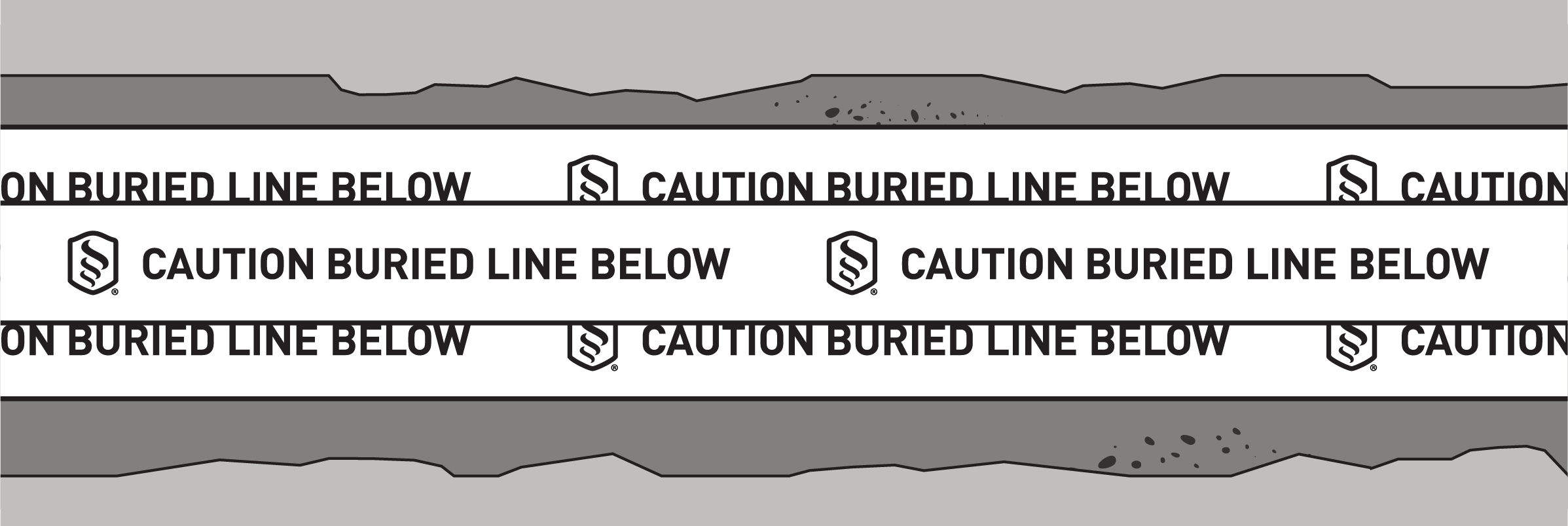
Best Practice: The width of warning tape should be greater than or equal to the width of the utility it is being buried over.
If the tape is narrower than the utility, there is a much greater risk that:
In either case, the warning system fails because it was never encountered.
When wider coverage is needed, multiple rolls of tape can be installed side by side (overlapping as needed) to ensure full protection along the utility's path.
This depends entirely on how the tape is constructed.
Standard extruded plastic marking tapes rely on material thickness and width for strength.
In these products, strength increases as width increases.
Signaltape® Products use a different construct than ordinary marking tape. Instead of relying on plastic film alone, they contains an aramid fiber core with a tensile strength of 3,000 lbf.
Because the strength comes from the core, not the plastic:
Signaltape® Underground Warning Tape features a sine wave construct embedded within the tape itself. This design allows the tape to be caught by an excavator bucket regardless of the angle of approach.
As the tape is pulled up by the excavator:
Not all underground tapes serve the same purpose. Using the wrong type can lead to gaps in protection.
The main purpose of warning tape is to provide a warning to an excavator to prevent accidental contact with buried utilities.
Warning tape is:
Examples of Warning Tape:
The main purpose of marking tape or marker tape is to assist in the location and identification of a utility. They should generally be equal to or greater than the width of the utility, and are often buried above it, but they are not designed to prevent excavation damage caused by machinery.
The primary role of these tapes is that they provide identification, which helps prevent mistakes such as tapping into the wrong line, which can be a serious safety risk.
These tapes are most often detectable, which aids in locating utilities. Accurate locating supports damage prevention but does not offer a physical warning system.
Examples of Marking Tape:
Boretrace® Detectable Marking Tape is a marker tape designed for HDD installation, since the tape is bored in with and directly against the utility, the standard width guidance does not apply. This product’s function is to ensure the utility can be accurately identified and located, not to act as a physical warning barrier.