
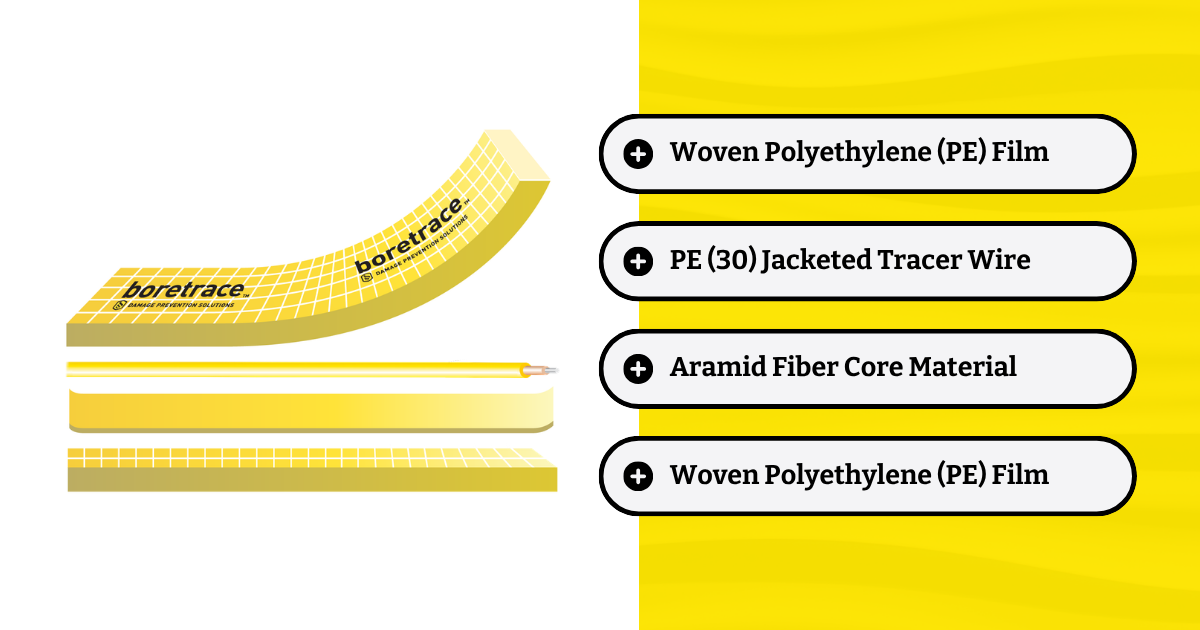
Horizontal directional drilling (HDD) places different demands on marking materials than open-trench installation. Boretrace® Detectable Marking Tape is constructed with woven film, an integral tracer wire, and a high-strength fiber core to provide utility identification and locating capability for utilities installed with HDD methods.
Two layers of woven polyethylene film form the exterior of Boretrace® Products. The woven material resists tearing and stretching better than conventional extruded plastic, helping the tape and embedded tracer wire better withstand the impacts associated with HDD installation methods.
The two film layers have a combined thickness of 11 mil. Polyethylene also provides excellent resistance to acids, good resistance to alkalis, and resistance to mildew and aging, making it appropriate for long-term use in buried environments.
In addition to supporting the tape’s physical durability, the film provides a printable surface for utility-specific legends.
Boretrace® Detectable Marking Tape contains an embedded 12 AWG copper-clad steel (CCS) tracer wire with a PE (30) jacket. The wire creates a dedicated conductive path that can be used with compatible locating equipment to identify the approximate route of the installed utility.
Incorporating the tracer wire into the marking tape keeps electronic detectability and visual utility identification together throughout the installation.
A woven aramid fiber core reinforces the construction of Boretrace® Detectable Marking Tape. The core has a break strength of 3,000 lbf. when tested to ASTM D6775 and adds durability for horizontal directional drilling installation conditions.
The aramid core supports the tape as it is installed with the utility, while the surrounding film and tracer wire provide identification and subsequent locating capability.
Color alone may not provide sufficient identification in congested underground environments. The components of Boretrace® Products work together to provide:
This combination allows the identification product to be installed alongside the utility rather than added above it through a separate open trench and was developed as an alternative to using multiple tracer wires with the bored utility.