
Construction today looks fundamentally different than it did a generation ago. Projects are larger, infrastructure is more interconnected, and teams have access to better technology, materials, and practices. The Modern Construction Environment reflects the cumulative effect of these changes and the new demands they place on how projects are designed, built, and ultimately protected.
The fundamentals of construction have not changed. Projects still need to be completed safely, on schedule, and within budget. What has changed is the environment in which teams are expected to accomplish those goals.
Projects today require coordination among a variety of contractors and engineering disciplines working around dense, interconnected infrastructure. Owners expect greater visibility into their projects. Engineers have access to more information during design. Contractors are expected to execute increasingly complex work while navigating persistent workforce and schedule pressures.
Four major shifts illustrate how these changes affect project planning, design, field execution, and the long-term protection of infrastructure:
Modern projects bring more infrastructure, digital systems, and stakeholders into a shared construction environment. Underground corridors can contain electric, gas, water, communications, fiber, and other critical infrastructure, while major projects require coordination across numerous disciplines and trades. New infrastructure also must coexist with assets installed years or even decades earlier.
The concentration of new and existing infrastructure creates a construction environment where one scope of work rarely exists in isolation. Decisions made by one team can affect the work of another, and unexpected conditions encountered in the field can create downstream effects across the project.
Underground utilities are a good example of this growing complexity. Existing infrastructure must be identified, located, protected, and incorporated into the design before new construction can move forward. When the information available during design does not match conditions in the field, teams may be forced to redesign, relocate infrastructure, or otherwise adjust construction plans.
The Federal Highway Administration (FHWA) has identified unexpected utility conflicts as a significant source of project cost and delay that can extend transportation projects by weeks or even months. The challenge is no longer simply building new infrastructure. Increasingly, it is building new infrastructure while safely navigating everything that is already there.
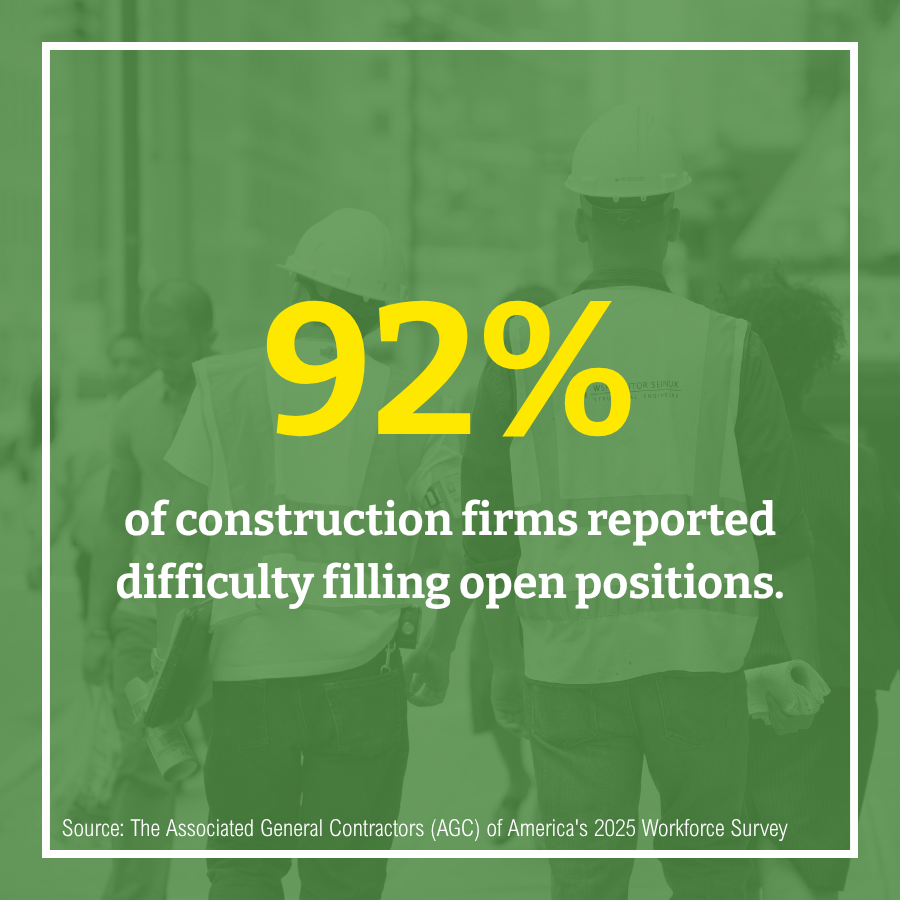
While projects are becoming more complex, construction teams are being asked to execute under significant schedule, labor, and cost pressures. Skilled labor remains one of the clearest examples. In the Associated General Contractors (AGC) of America's 2025 workforce survey, 92% of construction firms reported difficulty filling open positions, while 45% reported project delays caused by workforce shortages.
Workforce shortages affect more than hiring. When experienced workers are difficult to find, existing teams are asked to accomplish more with the people and resources available to them.
Schedule pressures compound the challenge. Delays in one area of a project can prevent another trade from beginning its work, leave equipment or crews idle, and push milestones further down the calendar. Problems requiring rework or additional coordination consume resources that may already be stretched thin.
Combined workforce, schedule, and cost pressures place greater importance on decisions made before crews ever reach the field. Clear specifications, better information, thoughtful designs, and materials selected for their performance can reduce unnecessary uncertainty during construction. The goal is not to eliminate the realities of field work. The goal is to give field teams the best possible conditions to execute their work correctly.
The infrastructure being built and protected is increasingly critical to how communities and businesses operate. Growing demand for energy, connectivity, manufacturing capacity, transportation, and water services is driving continued investment in power systems, fiber networks, pipelines, data centers, advanced manufacturing facilities, transportation networks, and water systems.
As infrastructure becomes more critical, the consequences of damage can extend well beyond the immediate construction site. A damaged asset requires more than a repair. Infrastructure damage can interrupt service, delay other work, idle crews, create additional costs, impact customers, and introduce safety risks. Even damage limited in physical scope can have consequences across multiple contractors, schedules, and systems.
The human consequences remain particularly important. Construction continues to be one of America's highest-risk industries. According to the Bureau of Labor Statistics in 2024, 1,034 construction workers died from workplace injuries, more than any other private industry sector.
The combination of greater project complexity, tighter schedules, more critical infrastructure, and higher consequences places greater responsibility on everyone involved in a project to consider risk throughout the design and construction process.
For engineers and owners, managing project risk requires looking beyond whether something can be built and considering how the infrastructure can be built, operated, maintained, and eventually worked around safely. The decisions made during construction can continue influencing field conditions long after the original project is complete.
As projects become more complex and the consequences increase, engineering practices have evolved in response. Engineers increasingly have tools that allow potential problems to be identified during design rather than discovered after construction begins.
Specifications have evolved alongside these technologies. Engineers can evaluate materials based on a broader range of characteristics, including strength, durability, service life, compatibility, detectability, and performance under specific field conditions.
Modern engineering practices share a common objective: identifying potential risks earlier and addressing them through design.
The growing emphasis on early risk identification represents an important shift in thinking. Instead of relying entirely on procedures or perfect execution in the field, modern engineering provides opportunities to build additional layers of reliability and protection into the project design.
Better information informs better designs. Better designs give field teams clearer conditions in which to work. Better material decisions can help those designs continue performing long after installation.
Project complexity, delivery pressures, critical infrastructure, and higher engineering expectations are changing what modern construction demands from the products and materials used in the field.
Projects have evolved. Technology has evolved. Risks and expectations have evolved. The materials specified for infrastructure projects should be evaluated through the same lens. As the construction environment continues to change, material selection must real-world conditions, identifiable failure points, documented performance, and long-term reliability.